We may earn commission from links on this page, but we only recommend products we love. Promise.
Tripp Trapp vs IKEA ANTILOP: What Does the Extra Money Buy?
The IKEA ANTILOP covers the basics for $24.99. Here's when the Stokke Tripp Trapp's adjustable seat and footplate justify a much bigger budget.
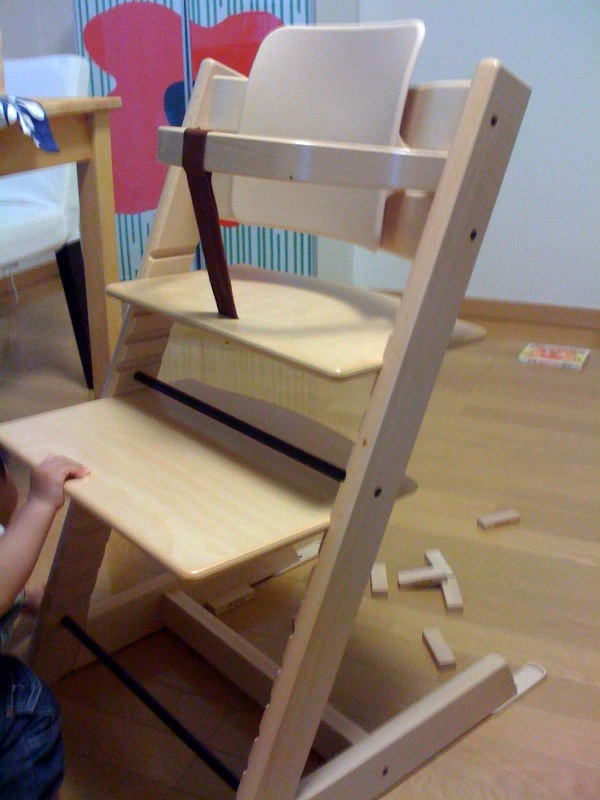
I’d buy the IKEA ANTILOP if the high-chair budget were tight. I’d choose the Stokke Tripp Trapp if adjustable seating mattered enough to pay for it and I wanted the chair to stay at our table beyond the baby stage. Both decisions make sense. The expensive one needs a reason that survives a look at your bank balance.
This comparison gets muddled when people put the price of a bare Tripp Trapp beside the price of an ANTILOP with its tray. Your baby needs the appropriate complete setup. Start there, then decide how much the differences matter.
The ANTILOP with tray was listed at $24.99 on IKEA’s US site when checked in October 2026. Stokke listed $399 as the regular price of its Tripp Trapp bundle with Baby Set, harness, and tray. Sale prices and finishes can change that gap, but at those figures you’re looking at $374.01 extra.
That’s enough money to deserve a proper explanation. “Everyone has one” won’t do.
The comparison that actually helps
| IKEA ANTILOP with tray | Stokke Tripp Trapp with Baby Set and tray | |
|---|---|---|
| Price basis | $24.99 listed price | $399 listed regular bundle price |
| Seat adjustment | Fixed seat | Seat height and depth adjust |
| Foot support | No included adjustable footplate | Adjustable footplate |
| Materials in the versions compared | Plastic seat and tray, steel legs | Beech chair with baby accessories |
| Longer-term purpose | High chair within its stated limits | Chair that can be reconfigured as the child grows |
| Strongest buying argument | Very low cost for the complete basic setup | More control over seating position and continued chair use |
Prices were checked October 7–8, 2026, before tax and delivery. Stokke’s page still displayed a promotion with an October 7 end date, so the comparison uses its regular price. Check the exact finish and bundle before ordering.
These are desk-researched editorial assessments of features, ownership, and value. We haven’t tested these chairs side by side, and the scores aren’t safety ratings.
IKEA ANTILOP: 8.5/10 for a small budget
The IKEA ANTILOP with tray makes an unusually clear offer: a basic high chair at a price that leaves room for everything else a baby needs. The version linked here includes the tray and safety belt.
Its score reflects that value and its uncomplicated construction. The fixed seat and lack of an adjustable footplate are the main compromises. A low price doesn’t make those differences disappear; they simply might be acceptable for your family.
Pros
- The $24.99 listed price includes the tray, making the starting cost easy to understand.
- Its plastic shell has no included upholstered seat cover to add to the laundry.
- The legs detach, which can help when the chair needs to travel or go into storage.
Cons
- You can’t adjust the seat height and depth as you can on the Tripp Trapp.
- There’s no adjustable footplate in the supplied setup.
- Its purpose ends within IKEA’s high-chair age and weight limits; it doesn’t convert into a regular child’s chair.
IKEA specifies use for children who can sit unaided, up to age three or a maximum weight of 33 pounds. Check the instructions supplied with your exact chair and stop at whichever limit applies first.
I’d consider it especially seriously for a grandparent’s home where a chair gets occasional use. Spending hundreds on a second high chair would need a specific justification. Check the child fits the seat and that the adults using it understand the restraint before the first meal.
Stokke Tripp Trapp: 8.5/10 for adjustability
The Stokke Tripp Trapp with Baby Set and tray earns its place through the adjustable seat and footplate. You can change both as your child’s dimensions change. That is a tangible difference from the ANTILOP.
Its score balances those adjustments and its continued use as a chair against a substantial upfront cost. The wooden silhouette may be part of the attraction, but the functional reason to pay more is the seating setup.
Pros
- Seat height and depth can be adjusted rather than accepted as one fixed position.
- The footplate adjusts, allowing you to set up foot support as your child grows.
- Once the baby accessories are no longer appropriate, the chair has a continuing purpose at the table.
Cons
- The complete baby setup costs considerably more than the ANTILOP.
- You have to follow the setup instructions and revisit the adjustments as your child grows.
- Choosing finishes, cushions, and extra accessories can push the total beyond the bundle you originally compared.
Use the Baby Set when your baby meets Stokke’s readiness requirements, including sitting unaided. Follow the US instructions for the harness and extended gliders. An age label on a shopping page isn’t a substitute for those requirements.
I wouldn’t buy a cushion simply because the styled product photograph includes one. Start with the components needed for the correct setup. You can decide about optional extras after you know what you’d actually use.
What an adjustable footplate can tell you
The Tripp Trapp gives you something specific to adjust under your child’s feet. The ANTILOP doesn’t include that feature. That difference deserves a plain description without a leap into promises about how much a baby will eat.
I’d want to see the child sitting in the correctly assembled chair before deciding whether the fit worked. Are they positioned as the manufacturer instructs? Can you set the seat and footplate appropriately? Is the restraint fitted correctly? Those observations are more useful than choosing from a photograph of an empty chair.
An adjustable chair still needs an adult to adjust it. If the settings stay where they were six months ago, you’re missing part of what you paid for. Keep the instructions somewhere you’ll find them when it’s time to move the seat or footplate.
For a child with feeding or positioning difficulties, ask their clinician for individual guidance. I wouldn’t use a shopping comparison to diagnose a seating problem or promise that one chair will resolve it.
I’d also be cautious about buying a basic chair and immediately adding several unapproved accessories to recreate a different model. Check compatibility with the chair manufacturer before making modifications. Once you’ve priced the extras, compare that total with an appropriately equipped chair from the start.
Cleaning starts with the parts you’ll touch every day
Picture yogurt in the restraint, dried oatmeal at the edge of the seat, and a piece of pasta under the tray. Those are the places worth inspecting in a store. A beautifully wiped display chair tells you very little about access to its awkward corners.
IKEA’s care instructions for the ANTILOP say to wipe with a mild soapy solution and dry with a clean cloth. I wouldn’t assume the whole chair or tray belongs in a dishwasher just because the seat is plastic. Follow the actual instructions.
With either model, inspect how the restraint is cleaned and refitted. The chair needs its restraint every time it’s used, so a plan that leaves the straps drying elsewhere at dinner is inconvenient. Allow for that in your routine.
The wooden chair’s appeal won’t remove the need to clean food from its accessories. Equally, the ANTILOP’s low price won’t make a badly neglected belt pleasant to handle. I’d compare the cleaning steps I could realistically keep up with, especially if several people share feeding duty.
Measure the floor, then the table
An ANTILOP seat can look compact while its legs occupy a larger patch of floor. IKEA lists the assembled width as 24 inches and depth as 26 inches. Mark that footprint with painter’s tape if the chair will sit beside the kitchen walkway.
For either chair, check the space where adults pull out their own seats, where the dishwasher door opens, and where someone carries hot food. A chair that fits under a tabletop in theory may still be awkward during a real meal.
If you’re choosing the Tripp Trapp to use at the table, check the table’s underside and apron against the intended setup. Follow Stokke’s placement instructions. Keep an eye on opportunities for a child to push against nearby surfaces, which can create a tipping risk.
The AAP recommends using the safety straps, including the crotch strap, supervising children in high chairs, and preventing climbing. Those habits apply at both price points. A tray doesn’t replace a restraint.
The years-of-use argument needs an honest household
The Tripp Trapp’s continued use is worth considering if you actually want it to become your child’s everyday table chair. Imagine where it will live after the tray goes away. If you have a clear answer, the longer lifespan has a practical purpose.
If you already plan to buy different dining furniture or prefer another seating arrangement later, don’t let a theoretical decade of use make the purchase feel cheaper than it is today. You still pay the full amount upfront.
I’d treat resale money as a possible bonus. Condition, local demand, missing parts, and the time involved in selling all affect what comes back. A future buyer shouldn’t be responsible for making your current budget work.
The same applies to passing a chair between siblings. It’s a reasonable possibility, but check the age gap and whether the older child will still use it. Sometimes “one chair for everyone” becomes two chairs because both children need somewhere to sit at once.
My buying decision
I’d choose the ANTILOP when keeping the initial cost low is the priority and its fixed setup fits the child appropriately. It deserves to be judged on that job. There’s no need to apologize for buying the $24.99 chair.
I’d choose the Tripp Trapp when I’d use the seat and footplate adjustments, wanted its later life as a table chair, and could comfortably afford the complete configuration. Those are strong reasons. The expectation that an expensive high chair will somehow make family meals serene is much shakier.
Before ordering either, verify what’s in the box, read the current US instructions, and measure the space where dinner actually happens. Then spend according to the features your family will use.